 TAP-Foley
ICLR 2027 · Anonymous submission
TAP-FoleyInference-Time Target-Anchored Projection
for Counterfactual Video Foley Generation
Change the sound identity. Preserve the timing.
VGGSound-Counterfactual · 1,189 videos · One source and 10 targets per video
Download the manifest: CSV JSONL
TL;DR
TAP-Foley is an inference-time guidance method for Counterfactual Video Foley Generation that suppresses the source sound identity implied by the video while retaining video conditioning throughout generation: at each step, it removes only the excess source-directed steering along a single source–target axis, mitigating the video–text conflict without dropping either modality. On our new VGGSound-Counterfactual benchmark, it achieves a more favorable trade-off between sound identity replacement and temporal alignment than the evaluated configurations of prior methods, improving temporal alignment by 20% over the strongest prior inference-time guidance method at matched replacement.
Abstract
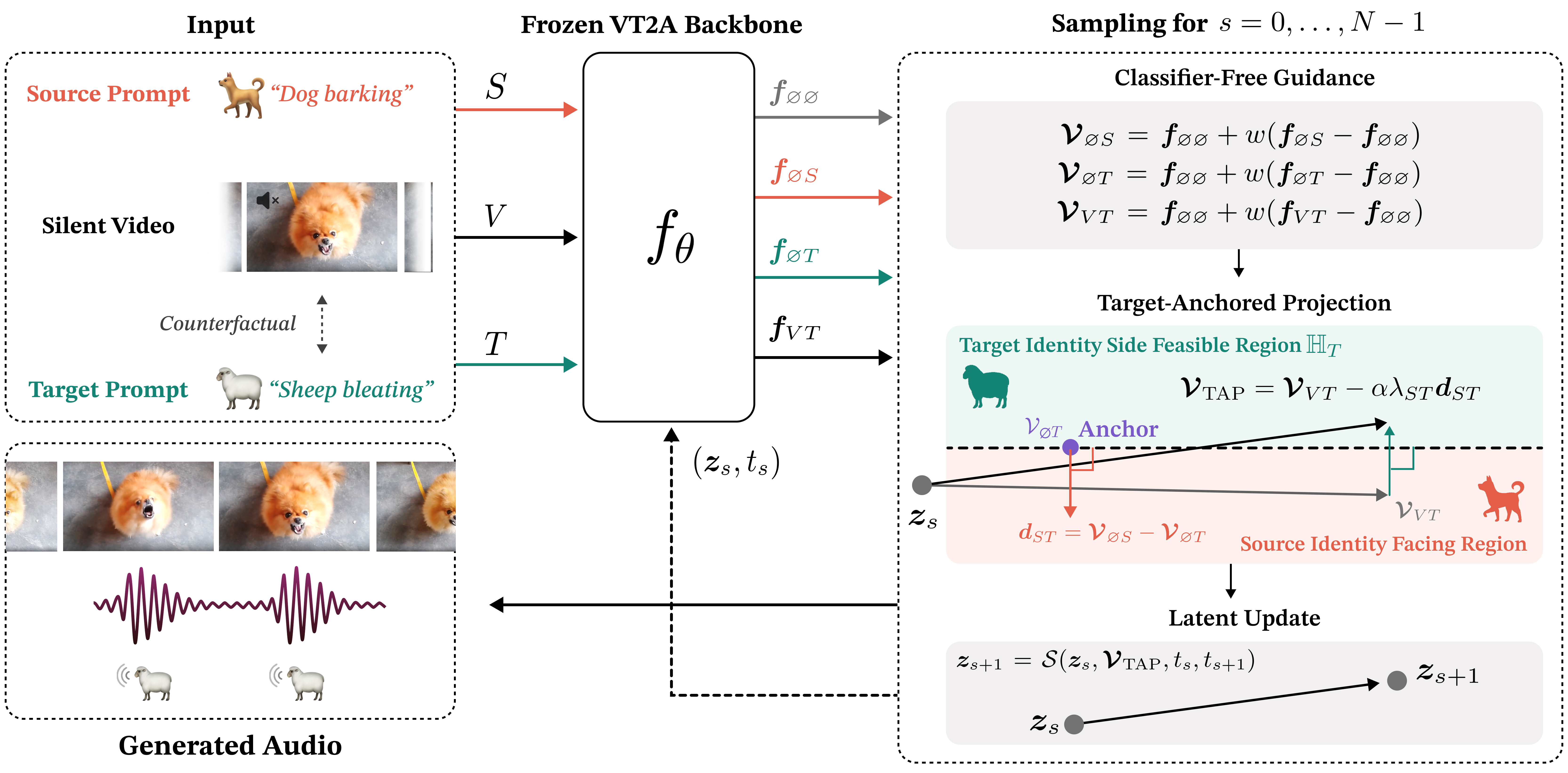
Counterfactual Video Foley Generation replaces the source sound identity that a silent video implies with the target sound identity that a text prompt describes, while preserving the timing of visible events. Video-text-to-audio (VT2A) models struggle with this task because video conditioning carries not only the timing but also the source identity, which conflicts with the target prompt. Existing training-based methods suppress the source identity by adding a visual adapter or by training on video–text conflicts, yet it remains partially audible. Inference-time guidance methods suppress it more fully, by negative source prompting with a fixed weight or by dropping video conditioning at an intermediate step, yet both degrade temporal alignment. We propose TAP-Foley, an inference-time guidance method that adaptively suppresses the source identity while retaining video conditioning throughout generation. At each step, it measures how strongly the video steers the prediction toward the source identity beyond what the target prompt alone would produce. It removes this excess along a single source–target axis with a scaled closed-form projection onto a target-anchored constraint, so the conflict between the two modalities is mitigated without dropping either. To reliably evaluate sound identity replacement and temporal alignment, we introduce VGGSound-Counterfactual, a benchmark for Counterfactual Video Foley Generation. Comprehensive experiments show that TAP-Foley achieves a more favorable trade-off between sound identity replacement and temporal alignment than the evaluated configurations of prior methods. At matched replacement, it improves temporal alignment by 20% over the strongest prior inference-time guidance method.
Method overview
See the action. Hear the target.
Compare both TAP-Foley backbones with six baselines on the same video and target prompt.
Curated examples from our user study, shown with method identities revealed. Each row is one video and target prompt; each column is one method. Use headphones: playing one clip pauses the others. Clips show the same opening segment, up to 8 seconds.
TAP-Foley (Ours) uses constant α = 1.2 on both MMAudio and Omni2Sound. Default CFG uses video + target prompt. These curated examples illustrate individual outputs.
Loading examples…